
Margo St. James didn’t set out to be a revolutionary. She was just a woman tired of being arrested for doing work that paid her bills. In the 1970s, she walked the streets of San Francisco as a sex worker, not out of desperation, but because it was one of the few jobs that gave her autonomy, control, and real income. That’s when she realized something: the system wasn’t punishing crime-it was punishing women for surviving. Her response? She started a movement. And it changed everything.
Today, if you search for dubai girls, you’ll find a very different landscape-one shaped by strict laws, cultural taboos, and underground economies. But Margo’s work laid the groundwork for the global conversation about consent, safety, and decriminalization that’s still unfolding. She didn’t just fight for herself; she fought for every woman who’s ever been called a whore and then denied basic human rights.
What She Did That No One Else Did
Before Margo, sex workers were invisible. Or worse-they were caricatures. The media painted them as victims or villains. Law enforcement treated them as criminals. Even feminists often dismissed them as symbols of oppression, not as people with agency. Margo flipped the script. In 1973, she founded COYOTE-Call Off Your Old Tired Ethics. It wasn’t a support group. It was a protest organization. And it didn’t ask for pity. It demanded rights.
COYOTE organized rallies, held press conferences, and even hosted ‘Hookers’ Balls’-fundraisers where sex workers danced, spoke openly, and collected donations. These weren’t parties. They were political acts. For the first time, sex workers were seen not as broken women, but as workers with unions, wages, and demands.
The Legal Battle That Changed Everything
In 1974, Margo and COYOTE filed a lawsuit against the San Francisco Police Department. Their argument? Arresting women for prostitution was a violation of equal protection under the law. Men who solicited were rarely charged. Women who sold sex were routinely jailed, humiliated, and forced into ‘rehabilitation’ programs that felt more like punishment than healing.
The case didn’t win in court. But it won in the court of public opinion. Newspapers ran headlines like ‘Whores on Trial.’ TV crews showed up. Suddenly, people were asking: Why are we locking up women for earning money with their bodies, while ignoring the men who pay for it?
That same year, Margo started the first-ever Sex Workers’ Rights Conference. It drew over 500 people-from lawyers to librarians, from feminists to former sex workers. No one had ever seen anything like it. And it wasn’t just about legal reform. It was about dignity.
She Didn’t Just Fight Laws-She Built Institutions
Margo didn’t stop at protests. She built real infrastructure. In 1975, she opened the first legal aid clinic for sex workers in the U.S. It offered free counseling, job training, and help navigating the court system. She hired former sex workers as staff. She trained lawyers to understand the realities of the trade, not the myths.
She also launched the first newsletter written by and for sex workers. It included job listings, safety tips, legal updates, and personal stories. One issue featured a woman who left the streets to become a nurse. Another told the story of a trans woman who found community for the first time. These weren’t headlines. They were lifelines.

The Global Ripple Effect
Her influence spread fast. In the 1980s, activists in Australia, Canada, and the Netherlands cited her as their inspiration. In Sweden, a law criminalizing buyers-instead of sellers-was directly shaped by COYOTE’s arguments. Even today, organizations like the Global Network of Sex Work Projects trace their roots back to Margo’s model.
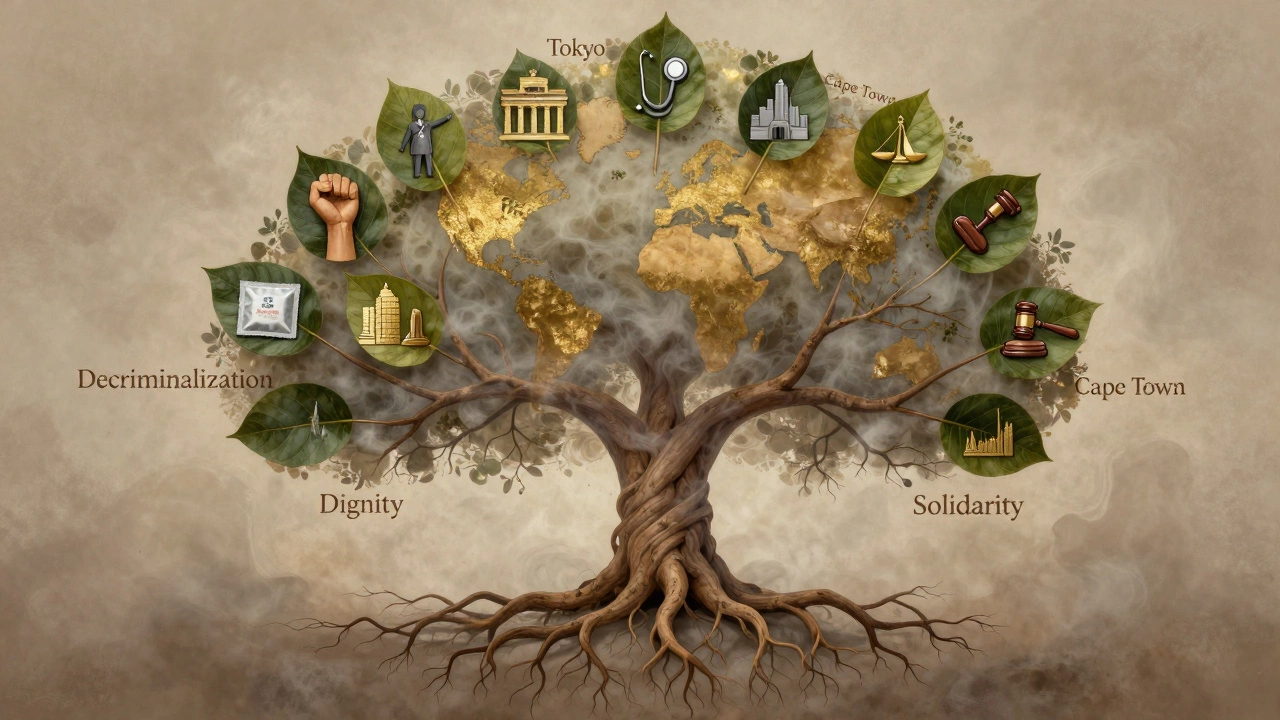
She traveled the world, speaking in Tokyo, Berlin, and Cape Town. In each city, she asked the same question: ‘Who gets to decide what’s moral?’ She didn’t push for legalization. She pushed for decriminalization. That’s the key difference. Legalization means the state controls you. Decriminalization means you’re treated like any other worker-with rights, protections, and dignity.
Why This Matters Today
Look at the headlines now. In places like Dubai, the conversation around sex in dubai is still locked in secrecy and fear. Women are arrested, deported, or worse. Men pay without consequence. The power imbalance is extreme. But Margo’s legacy reminds us that change doesn’t come from silence. It comes from speaking up-even when you’re called a whore.
Her work showed that sex work isn’t inherently harmful. It’s the stigma, the violence, and the criminalization that make it dangerous. When you remove the laws that punish workers, you make space for safety. You let them report abuse. You let them access healthcare. You let them unionize. You let them live.
Her Lasting Impact
Margo St. James died in 2021 at age 79. But her ideas are more alive than ever. In 2023, New York City passed a bill to expunge thousands of prostitution convictions-many of them held by Black and Latina women. The lead organizer said, ‘We’re standing on Margo’s shoulders.’
Her name is now taught in sociology courses at Stanford and Columbia. Her speeches are archived by the Library of Congress. And in 2025, a documentary about her life premiered at Sundance-titled Whore: The Woman Who Said No.
She didn’t want to be a hero. She just wanted to be left alone. But she changed the world anyway.
What She Taught Us About Power
Margo’s greatest lesson wasn’t about sex. It was about power. She saw that the real crime wasn’t selling sex-it was denying women the right to control their own bodies, their own labor, and their own futures. She understood that morality is often just a tool used by those in power to control the powerless.
Today, when you hear politicians talk about ‘protecting women,’ ask: Protecting them from what? From earning money? From choosing their own work? From being treated like humans?
Margo didn’t believe in saviors. She believed in solidarity. And that’s why her legacy endures.
Her Words, Still True
In her memoir, she wrote: ‘I didn’t choose to be a whore. I chose to survive. And if surviving is a crime, then the law is the real criminal.’
Those words still echo. In brothels in Bangkok. In alleyways in Toronto. In hidden apartments in Madrid. And yes-sometimes, in places where dubai sex is whispered but never named.
Where Her Fight Continues
Organizations like the International Committee for Prostitutes’ Rights still use COYOTE’s original handbook. In South Africa, sex workers run mobile clinics funded by donations. In the Philippines, former sex workers now train others in digital safety and financial literacy. All of it traces back to one woman who refused to be silenced.
She didn’t wait for permission. She didn’t ask for approval. She just started. And that’s the real lesson.
Today, if you want to honor her, don’t just read about her. Support sex workers’ rights organizations. Challenge the language that dehumanizes. And remember: the fight isn’t about whether sex work is moral. It’s about whether people deserve safety, dignity, and the right to choose.
And if you’re ever tempted to look away? Think of Margo. She didn’t look away. And neither should you.
It’s not about the act. It’s about the person.
And she was a person.
That’s all she ever asked for.